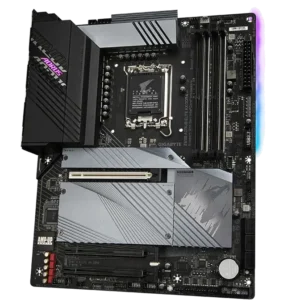



ROG Zenith II Extreme
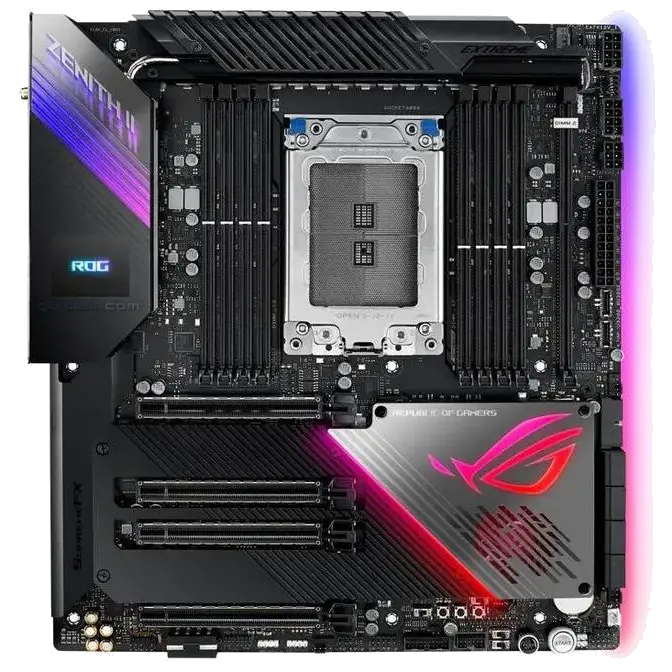
Expertly engineered for those who demand full control, ROG Zenith II Extreme is future-proofed, ready for anything in the pipeline. It's primed to unleash the full force of the latest 3rd Gen Ryzen Threadripper processors, while keeping thermals in check with a comprehensive cooling solution. Maximized lane bandwidth lets you connect up to 33 devices simultaneously, while every single PCIe x16 and M.2 slot is wired with PCIe® 4.0 – so you're free to equip next-gen graphics cards or NVMe drives without fear of bottlenecks. Massive power, massive bandwidth.

Performance
High-end desktop processors have greater power requirements due to the abundance of cores and memory channels. The latest Threadripper evolutions are particularly demanding, so intelligent VRM design and quality components are vital – especially for overclocked CPUs that live closer to the edge of stability. Accompanied with our critically-acclaimed UEFI and AI Suite tuning utility, ROG Zenith II Extreme offers an accessible range of manual tweaking tools, plus a highly-configurable auto-tuner that maximizes system control and performance with no expert knowledge required.
Teamed Power Architecture
Modern CPU architectures up the ante for motherboard power design by transitioning from deep power saving modes to full load almost instantaneously. Our latest VRM architecture rises to the challenge by utilizing teamed power stages to rapidly swing current, while maintaining exemplary thermal performance.

We became the first manufacturer to implement phase-doublers when we shipped our A8N32-SLI Deluxe motherboard, back in 2005. The board's VRM was lauded for elegantly overcoming the power handling capabilities of components that were available at the time and also reducing voltage ripple. Those benefits led to phase-doublers becoming universally accepted in the industry, and they are still used for similar purposes today.

While doublers help extend the number of effective phases, they do so at the cost of a processing delay.

However, the current crop of CPUs pack more cores than their predecessors, and the latest instruction sets allow them to crunch computationally-dense workloads at an incredible pace. As an added bonus, they also consume less power at idle and can transition between loads states much more quickly. These improvements necessitate a re-evaluation of power-design priorities because phase-doublers add a propagation delay that hampers transient response.
The teamed architecture allows two power stages to work in tandem to provide more power to the CPU.
Fortunately, the latest integrated power components can handle higher currents than the devices of yesteryear, making it possible to implement a simple circuit topology that isn't hamstrung by the processing lag of phase-doublers. That's why ROG Zenith II Extreme utilizes teamed power stages to deliver higher burst current per phase, while maintaining the thermal performance of phase-doubled designs.
Learn more about Thermal Comparison Result
Teamed Solution
Phase-Doubled Solution
Pitting the teamed VRM against a phase-doubled solution results in near identical thermal performance.
The MOSFETs within the power stages generate the most heat as they are responsible for voltage conversion and delivery to the CPU from the 12V EPS connector.
Each VRM component serves a specific purpose. PWM controllers and phase-doublers control the circuit, and the power stages do the heavy lifting from an electrical and thermal standpoint. That's why ROG Zenith II Extreme utilizes 16 Infineon TDA21472 power stages. The TDA21472 sits at the top of Infineon's lineup and features a low RDSON to reduce switching and conduction losses, helping to improve overall thermal headroom.
Dual 8-pin & one 6-pin ProCool II power connectors
Three ProCool II connectors ensure a snug and reliable connection to the EPS 12V power lines.
Connectivity
Having the bandwidth to fuel multiple PCIe SSDs and graphics cards is part of the allure of high-end desktop platforms. ROG Zenith II Extreme fully exploits Threadripper's 64-lane capability, empowering you to connect up to 20 PCIe devices simultaneously. Every single PCIe x16 and M.2 is wired with PCIe 4.0, and the board also accelerates both wired and wireless networking – with both Aquantia 10 Gbps Ethernet and the latest Wi-Fi 6 (802.11ax) onboard.
Storage
ROG Zenith II Extreme supports up to five M.2 drives for maxed-out storage. Two ride the ROG DIMM.2 module, next to the memory slots, and support drives up to 110m. There are another two slots under the aluminum heatsink cover, with a fifth one at the rear of the board. Every one of these slots is wired to support full PCIe 4.0 bandwidth, so they're compatible with the very latest NVMe SSDs – laying the foundation for the ultrafast transfer speeds needed to support machine-learning algorithms and drive higher-resolution game textures.

AMD StoreMI
AMD StoreMI is a software utility that accelerates any drive for better system responsiveness with reduced startup and software load times. It combines SSD performance with the affordability and capacity of an HDD by automatically moving frequently accessed data to dedicated SSD storage.
Cooling
Great power requires great cooling, so ROG Zenith II Extreme employs large VRM heatsinks that strike the right balance between surface area and mass. The chipset heatsink integrates an active-cooling solution, helping to keep the underlying silicon stay cool under pressure, and also employs the same airflow to chill the SoC VRM. The extra-large heatsinks also cover multiple M.2 slots, meaning Zenith II Extreme is fully armed to provide the best foundation for extreme PC systems – enabling higher performance at lower temperatures.
Cooling Heatsinks
-
VRM heatsink
A VRM heatsink is placed on the MOSFETs and chokes, and the embedded heatpipe connects to the aluminum I/O cover. -
Aluminum I/O cover
An aluminum I/O cover is connected to the primary heatsink via an embedded heatpipe, increasing mass and surface area. -
Aluminum heatsink cover
The heatsink cover is crafted from pure aluminum to efficiently cool the two onboard M.2 drives. -
DIMM.2 heatsinks
The ROG DIMM.2 module now passively cools M.2 drives with metal heatsinks that also keep your build looking clean. -
Solid steel backplate
A steel, cold-rolled coil construction backplate strengthens the motherboard to prevent bending, and adds additional mass to siphon heat from the VRM. -
SoC VRM Heatsink
Designed to cool the vital motherboard chipset area. -
Chipset heatsink
A chipset heatsink blends seamlessly with the aluminum heatsink cover and prominently features the ROG logo.
Audio
Sound is an integral part of gaming immersion. ROG Zenith II Extreme's onboard audio joins the latest SupremeFX S1220 codec with a high-end ESS Sabre DAC. Power users in particular pipe content through multiple devices, so our Sonic Studio III software has an intuitive management interface that lets you route sound from applications to specific outputs. The board even supports DTS® Sound Unbound technology, to create three-dimensional audio soundscapes that draw you further into virtual worlds.